Use of arrow keys when focused on the Google language option field will translate site content on the fly. Use your enter key to review all options and choose your selection before applying.
The Richland School District receives money from four sources:
Federal Government (about 10%)
State of Wisconsin (about 65%)
Local via property taxes (about 20%)
Grants (about 4%)
Other sources such as interest, school fees, etc. (1%)
Property Taxes are established via referendum when district residents vote on the level to which they are willing to be taxed to help fund the school district. This level is called the mill rate, or the taxes property owners pay per $1,000 of fair market property value they own. The Richland School District has maintained a stable mill rate since 2020 at $9.12.
Though the tax rate has not changed, individuals may see increased school taxes due to increased property values.
Levy dollars support student enrichment programs not fully funded by the state, such as:
Student programs
Teacher pay, for additional teachers above the state minimum
Instructional assistants in classrooms
Textbooks, curriculum, and teacher training
Additional course offerings for students
Athletics
Arts and music
Special education
Bus transportation (not fully funded by the state)
Building and grounds maintenance (not fully funded by the state)
Computers and technology
Gifted education programs
Community use of facilities
Why are voters asked to approve levies every two to four years?
By law, operations levies can only be proposed for a period of four years or less. Typically, school districts propose levies of two, three, or four years. After the allotted number of years, the levy expires. Voters must approve a renewal of funding, or local financial support for schools. Generally, the levy you are voting on simply replaces one that is about to expire.
By law, bonds may not be used to pay for the day-to-day costs of operating schools or school districts. Bonds provide funds only for capital projects, such as:
Resurfacing parking lots/fixing roofs
Updating buildings through the replacement of aging infrastructure (like HVAC systems, technology, etc.)
Renovation or modernization of schools and athletic facilities
How does the Board of Education decide what questions to ask and their tax impact?
District Administration and the Board of Education take this process seriously, balancing the priorities of the district to fund "people, properties, and programming" with the desire to keep taxes affordable to district property owners. They follow a lengthy process in making this decision:
The District Administration, together with the Board of Education committees, establish the District's needs and priorities. To set priorities, the District gathered this information via staff and parent surveys in 2023. The results were distilled into 3 priorities:
Making Connections with Students and Addressing Their Mental Health
Recruiting and Retaining High-Quality Staff
Get Our Students College and Career Ready
Additionally, the District partnered with Nexus Solutions to conduct a study of all RSD facilities to create priorities and estimate costs for improvements and updates of priorities.
The District Administration then creates an itemized "wish list", with estimated costs and tax impacts (in 2023, these ranged from NO tax impact to an additional $1.40 per $1,000 of property value). This was presented to the Board of Education. This information is publicly available in our Board Books here.
To help determine what rate voters will support and which wish list items constituents support, the District partnered with the Morris Leatherman Company to poll 400 randomly-selected RSD residents. The results of the survey were presented in a Special Board Meeting, which was recorded and posted here.
The District Administration and Board work together to analyze voter feedback data and, if appropriate, propose two questions to voters based on the level of support indicated in the phone survey. In a given calendar year, the District can propose ONE Operational and ONE Capital Improvement question to voters. The question is proposed to voters on the ballot.
If the referendum passes, the District can begin to work through its wish list of items based on the feedback of priorities it received from voters during the randomized poll. If it fails, the District must make the appropriate cuts to maintain a balanced budget.
Private School Vouchers
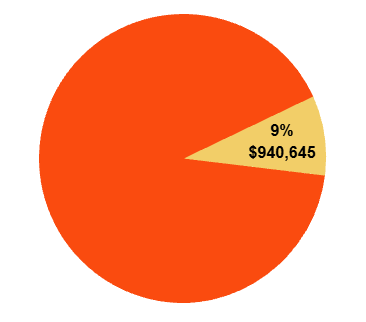
The Richland School District’s total property tax levy for the 2026-27 school year is $10,424,568. This includes funding for District operations and debt service, as well as nearly $1,000,000 for the state-mandated private school voucher program.
The private school voucher program is a state-mandated program that provides tax dollars for eligible students to attend participating private schools. This funding supports both local private schools and online private schools across the state. These funds do not benefit Richland School District students or programs. The $940,645 shown on the left represents the portion of the Richland School District levy required by law and allocated to the private school voucher program for the 2026-27 school year.
If you have questions about your School District taxes, referendum, or school funding, please reach out to the District Business Official.